Quad Nations Take Tough Stand on China, Terrorism and Critical Minerals at Delhi Meet
News Mania Desk/ Piyal Chatterjee/ 26th May 2026

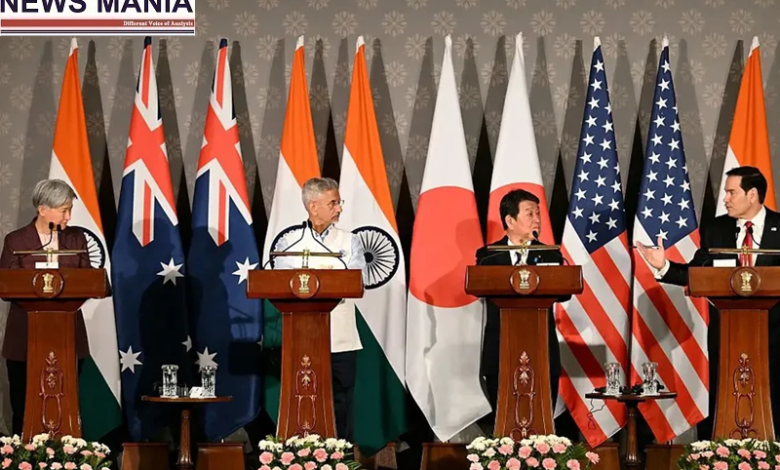
The Quad countries — India, the United States, Japan and Australia — adopted a firm position on regional security, terrorism and supply chain resilience during the Quad Foreign Ministers’ meeting held in New Delhi on Monday. External Affairs Minister S. Jaishankar hosted the high-level discussions, which were attended by US Secretary of State Marco Rubio and senior representatives from Japan and Australia.
The meeting focused on strengthening cooperation in the Indo-Pacific region amid growing geopolitical tensions and concerns over China’s expanding influence. In a strongly worded joint statement, the Quad reaffirmed its commitment to ensuring a “free, open and inclusive Indo-Pacific” while raising concerns about coercive activities in disputed maritime regions, particularly the South China Sea.
Although the statement did not directly name China in every reference, the messaging was widely viewed as a response to Beijing’s aggressive territorial claims and its dominance over critical mineral supply chains. The four nations stressed the importance of creating secure and diversified networks for critical minerals, which are essential for manufacturing semiconductors, electric vehicles and advanced defence technologies.
As part of the initiative, the Quad announced plans to deepen collaboration in mining, processing and recycling critical minerals. Reports indicated that the grouping aims to support investments worth billions of dollars to reduce global dependence on a single country for strategic resources.
Counter-terrorism was another key issue discussed during the summit. Jaishankar reiterated India’s position of “zero tolerance” toward terrorism and emphasised that countries affected by terror attacks have the right to defend themselves. The ministers also discussed enhancing maritime security cooperation, regional connectivity and infrastructure partnerships across the Indo-Pacific.
The meeting took place against the backdrop of increasing uncertainty in global trade and security caused by conflicts in several regions, including West Asia. Rubio described the Quad partnership as “more important than ever,” dismissing suggestions that the alliance had lost relevance. China later reacted to the discussions by cautioning against bloc politics and warning that regional partnerships should not target any specific country. Beijing said such groupings could undermine regional stability and trust.