Narendra Modi’s Long Political Run — Leadership, Stability, and the Road Ahead
Ms.Bornali Biswas –Editor in Chief

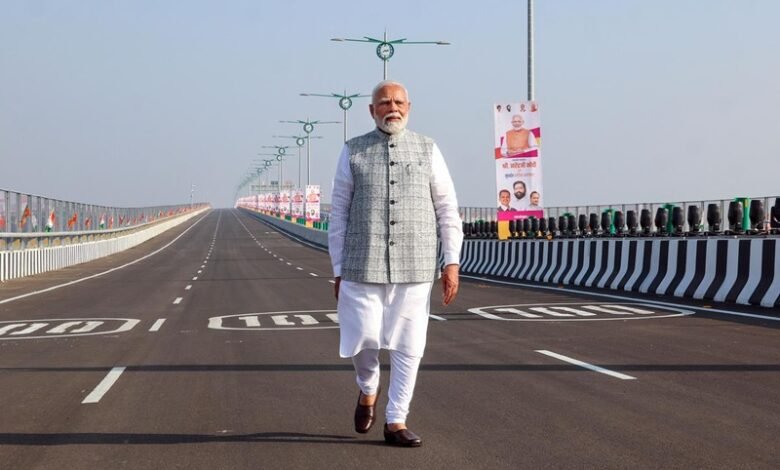
Narendra Modi has achieved a remarkable political milestone by becoming one of the longest-serving heads of government in India’s history. From his uninterrupted tenure as Chief Minister of Gujarat to his leadership as Prime Minister since 2014, Modi has demonstrated rare political durability in a country once defined by coalition instability and shifting mandates. Surpassing the record of Pawan Kumar Chamling, his 8,931-day journey reflects not just longevity, but sustained public relevance.
In a nation where political volatility was once the norm, Modi’s leadership has ushered in an era of relative stability at the Centre. His ability to secure three consecutive terms—despite a strong and often vocal Opposition—underscores both his political acumen and his connection with a large segment of the electorate. While the Opposition remains fragmented, with regional parties pursuing their own agendas and the Indian National Congress struggling to provide cohesive leadership, Modi has capitalized on this vacuum with clarity of messaging and decisive governance.
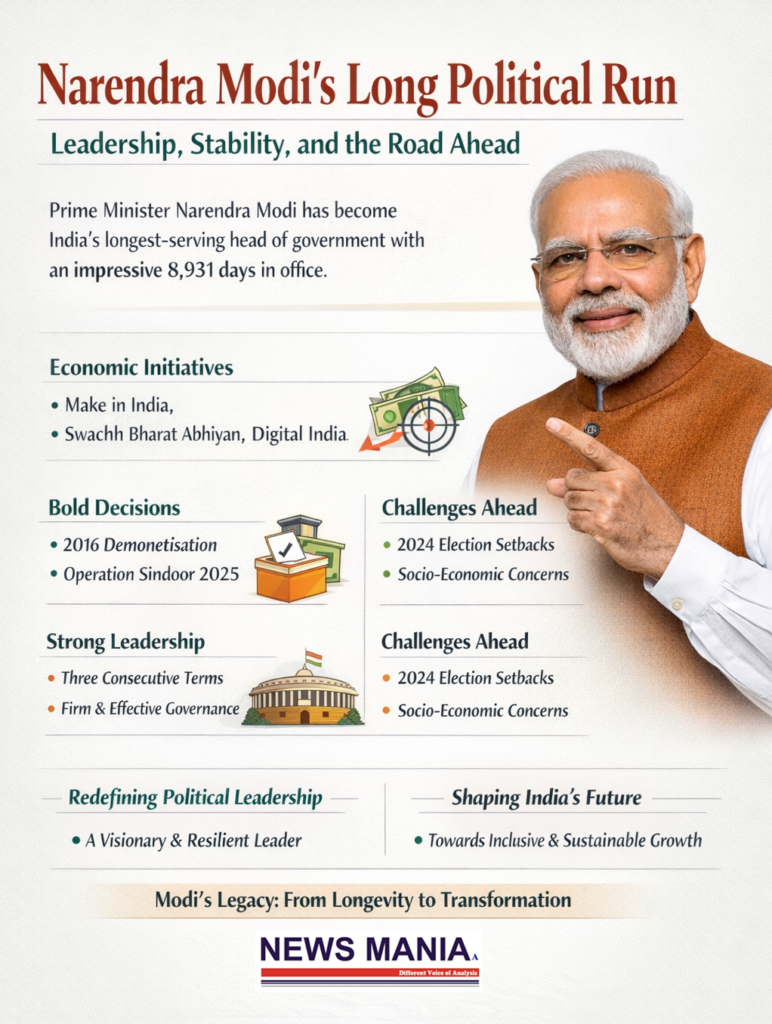
A defining feature of Modi’s tenure has been his emphasis on strong administration and policy continuity. His experience in Gujarat provided him with a solid administrative foundation, enabling him to navigate complex national challenges. Initiatives such as Make in India, Swachh Bharat Abhiyan, and Digital India have not only driven economic growth but also reshaped governance by promoting efficiency, transparency, and technological integration.
Critically, Modi’s leadership has also been marked by bold decision-making. The 2016 demonetization in India, announced on November 8, was officially aimed at curbing the “black economy,” eliminating counterfeit currency, and reducing terrorism financing and huge number of fake currency smuggled in India. While the opposition heavily criticized the move—terming it a “draconian” and “poorly planned” step that severely impacted the informal sector—the government proceeded to address key structural and political objectives., though controversial and debated—especially with the Reserve Bank of India reporting a 99.3% return of currency—reflected his willingness to take risks in pursuit of systemic reform. Similarly, decisive national security responses like Operation Sindoor demonstrated India’s evolving strategic posture, reinforcing deterrence while avoiding escalation. Operation Sindoor was a successful, non-escalatory retaliatory strike by India against terror infrastructure in Pakistan-occupied Jammu and Kashmir (PoJK) and Pakistan’s Punjab province, killing over 100 terrorists. It targeted facilities belonging to Lashkar-e-Taiba, Jaish-e-Mohammed, and Hizbul Mujahideen. Key results included destroying nine terror launchpads, proving advanced indigenous weapon systems (like the Akash missile), and establishing strong cross-border deterrence Leadership is about both successes and failures.
At the same time, Modi has largely maintained institutional boundaries, relying on governance mechanisms rather than overt overreach. His leadership style—firm yet calculated—has contributed to India’s stable political and economic trajectory over the past decade.
However, challenges remain. The 2024 general elections indicated a shift in electoral dynamics, suggesting that while Modi’s appeal remains strong, it is not unassailable. Questions about employment, economic inclusivity, and social cohesion continue to shape political discourse. Moreover, the Bharatiya Janata Party’s reliance on ideological mobilization—often supported by the Rashtriya Swayamsevak Sangh—raises questions about the long-term balance between governance and political strategy.
Yet, even critics acknowledge that Modi has redefined political leadership in India. His ability to combine vision with execution, stability with ambition, and national pride with global positioning has set a new benchmark. As he enters the next phase of his tenure, the focus will not just be on sustaining power, but on deepening impact—ensuring that India’s growth story becomes more inclusive and resilient.
In the final analysis, Narendra Modi’s long political run is not merely about numbers; it is about reshaping India’s political narrative. His legacy, already significant, will ultimately be judged by how effectively he translates longevity into lasting transformation.