Women’s Reservation: A victim of political gamesmanship?
Rajesh Kumar Singh / New Delhi / 22nd April 2026

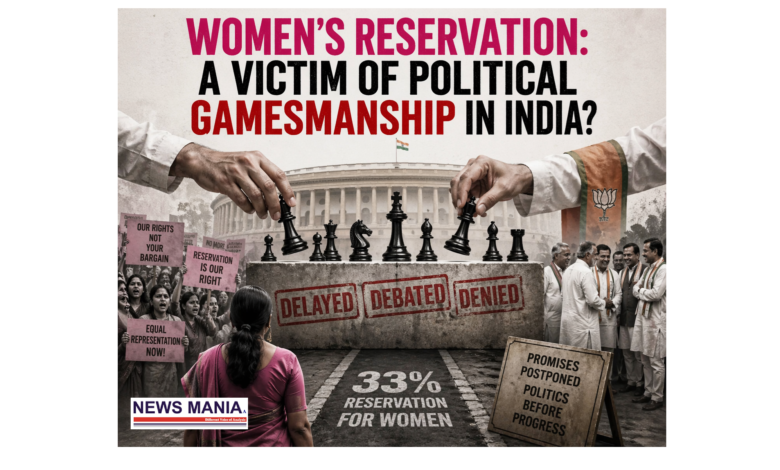
April 17, 2026, was recorded as a decisive turning point in the history of the Indian Parliament when the 131st Constitutional Amendment Bill (Women’s Reservation Bill) failed to secure the necessary two-thirds majority in the Lok Sabha. At the core of this failure were not just legislative hurdles, but deep-seated political maneuvering and a deepening conflict over the power balance between the North and South Indian states.The government’s primary plan was to provide representation for women without affecting existing seats. To achieve this, a proposal was made to increase the number of Lok Sabha seats from 543 to approximately 850. However, the opposition—particularly the INDIA bloc—termed this an “electoral gimmick” under the guise of women’s empowerment. Leaders like Shashi Tharoor cautioned against it, calling it a “Trojan Horse” and suggesting that there were hidden objectives behind the move.
The greatest concern for the Southern and Northeastern states revolved around the basis of Delimitation. If the number of seats were increased based on the 2011 (or upcoming) census, states like Tamil Nadu and Kerala would have to suffer a ‘penalty’ for their success in population control. The opposition argued that this would increase the dominance of states like Uttar Pradesh and Bihar in the Lok Sabha to such an extent that the political influence of the South and Northeast would become negligible. It was this regional insecurity that brought a scattered opposition together on a single platform.
During the 21-hour marathon discussion, the opposition opened another strategic front: a separate reservation for OBC women. It was argued that without a “quota within a quota,” this law would remain limited to women from privileged classes. The inability to reach a consensus between the government and the opposition on these dual issues of social justice and regional autonomy became the primary reason for the bill’s collapse.Critics believe that if the government had been truly serious, the reservation could have been implemented as early as 2024 or 2029 by decoupling it from the complexities of delimitation. The failure of the bill means that Indian women may now face a long wait until 2034 for their constitutional rights.
The proud dreams of Indian women have been intentionally shackled by a controversial process like “delimitation,” which itself faces questions regarding its fairness. This future delimitation will reward states that failed to control their population with greater political power, while states that set benchmarks in governance, education, and development will be penalized for their success with political marginalization.In a true sense, is this the message we want to send to the world—that the political significance of states making the greatest contribution to nation-building will be erased? The government introduced this proposal with the same short-sighted haste witnessed during demonetization.
History bears witness to the scars left by the haste of demonetization. Today, through delimitation, the government appears to be preparing for a similar kind of “political demonetization.” This is not merely a calculation of seats; it is a gamble with democracy, the price of which will be paid by the nation’s developed and socially aware states.It seems as though the rightful constitutional rights of Indian women have been entangled in a web of “administrative bargaining,” where the exit is lost in the fog of political maneuvering.The primary reason for the failure of the Women’s Reservation Bill was the government’s strategy of trying to silence opposition by increasing the total number of seats. However, this tactic backfired, as it struck at the very foundation of India’s federal structure and regional representation. By transforming the issue from a matter of women’s rights into one of “political and administrative complexity,” the opposition ensured the government ultimately failed to muster the necessary majority in the House.
The dreams of Indian women have been intentionally tethered to a controversial political process—delimitation—which is itself under intense scrutiny. This future delimitation is set to reward states that failed to control their population with increased political power, while states that achieved milestones in governance and development will be penalized for their success through political marginalization.Are we really prepared to send a message to the world that excellence in nation-building results in a loss of political relevance?The strategy behind the failure of the Women’s Reservation Bill was the government’s attempt to quell dissent by increasing the total number of seats. However, this very tactic became the cause of its downfall, as it raised fundamental questions about regional representation and India’s federal structure. By framing the issue as a “political and administrative complexity” rather than just a matter of women’s rights, the opposition successfully prevented the government from securing the required majority.
Rajesh Kumar Singh is a Political Editor -New Delhi