Exit Polls Not Always Infallible, But May Hold for West Bengal Polls: Experts
By NM National Political Correspondent/Kolkata, 3 May

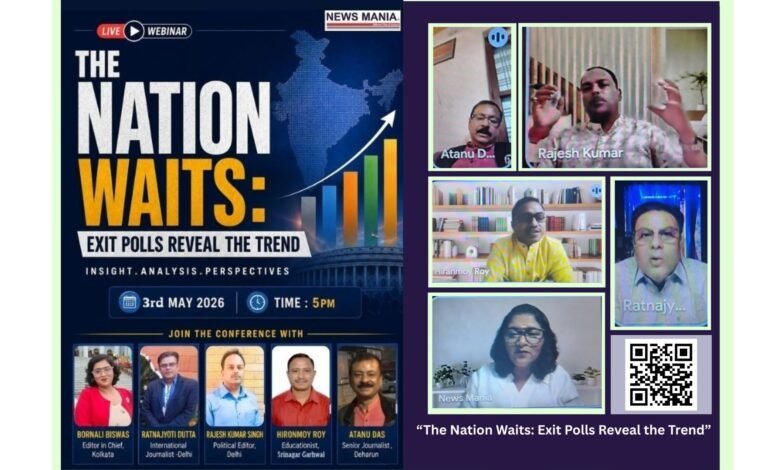
An exclusive webinar on the eve of the high-pitched West Bengal Assembly polls examined the fallibility of exit poll predictions. A majority of the polls indicated a closely contested election, with some suggesting a positive bias toward the Bharatiya Janata Party (BJP), while placing the ruling Trinamool Congress (TMC) on the back foot.
News Mania organised the webinar on exit poll predictions, bringing together journalists, a political commentator, and an educationist for an hour-long discussion.
“Majority of the exit polls indicate a landslide victory for the BJP, and I am going with those predictions,” said Atanu Das, a senior journalist who has served the premier national news agency, the Press Trust of India (PTI).
Das was the first panellist to air his views after Bornali Biswas, Editor-in-Chief of News Mania, initiated the discussion on May 3, a day ahead of the West Bengal poll results.
Das, having nearly four decades of journalistic experience, expressed confidence that a change of regime was on the cards and that the TMC government, led by Chief Minister Mamata Banerjee, would come to an end after 15 years in power in the eastern state.
The second panellist, Dr Hironmoy Roy, brought an educationist’s perspective to the discussion, titled “The Nation Waits: Exit Polls Reveal the Trend.”
“The accuracy of exit polls depends on the soundness of the scientific statistical methods and sampling techniques adopted for the survey,” Dr Roy said.
An economist by training who teaches at a central university in Uttarakhand, Dr Roy emphasised that credible exit poll predictions must include economic and development indicators.
“We need to understand the aspirations of the youth—income, employment, infrastructure creation, digital infrastructure, and the sports ecosystem,” he added.
Offering a global perspective, Delhi-based international journalist Ratnajyoti Dutta remarked, “Exit poll forecasts should not be taken as sacrosanct but always with a pinch of salt.”
Dutta recalled how exit poll predictions went drastically wrong during the British parliamentary elections in 1992, when most forecasts suggested that Prime Minister John Major-led Conservative Party would lose to the Labour Party. Contrary to those predictions, Major secured victory for the Conservatives.
Dutta pointed out that Allan Lichtman, a noted poll forecaster who successfully predicted the outcomes of U.S. presidential elections since 1984, failed to foresee Donald Trump’s return to the White House for a second term. Instead, he predicted a win for Kamala Harris.
Rajesh Kumar Singh, a political expert joining the webinar from Patna, observed that many exit polls appeared similar because they failed to reach last-mile voters in rural areas, relying instead on urban-centric, particularly Kolkata-centric, sampling.
“Let us wait and watch till the grand finale on May 4, when every prediction will be tested against the final verdict of the people of Bangla,” Biswas said in her concluding remarks.