Kerala’s VD Satheesan’s Significant Political Journey Is Summed Up in a 3-Km Journey
News Mania Desks/ Piyal Chatterjee/ 14th May 2026

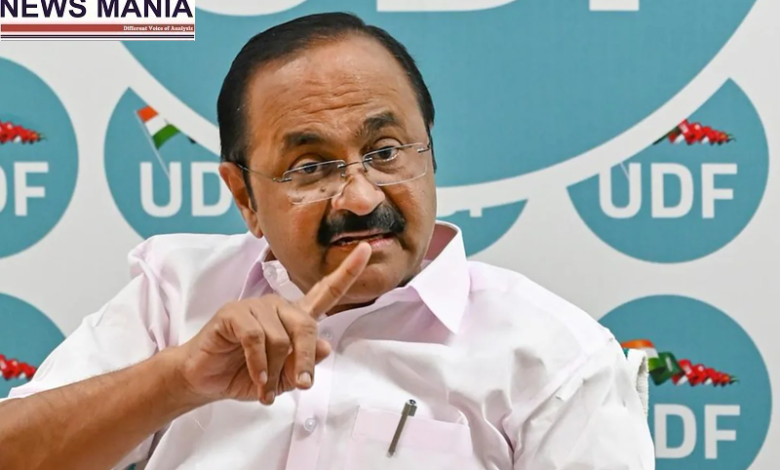
In the center of Thiruvananthapuram, the Cantonment House and Cliff House are only three kilometers apart. However, that little trip tells the tale of one of the most dramatic political turnarounds in recent memory for VD Satheesan, who is set to become Kerala’s thirteenth chief minister.
Leaders awaiting another opportunity at power have frequently resided in Kerala’s Leader of the Opposition’s official mansion, Cantonment House. The chief minister’s official mansion, Cliff House, serves as the state’s political hub. On the map, the two are not that far apart. But crossing the political divide can take years.
Few people thought Satheesan would be the man to complete that voyage after the Congress-led UDF was destroyed in 2021. The Congress was deeply rattled by the defeat. With history on its side, the Left had won successive terms in Kerala, making it the first front to do so in decades. Satheesan took over a cadre that lacked direction, a demoralized opposition, and faction-ridden leadership conflicts.
He returns to Cliff House five years later as the guy who restored the UDF and brought it back to dominance.However, Satheesan had a difficult journey to become chief minister despite the UDF’s resounding victory of 102 seats. Two prominent Congressmen, KC Venugopal and Ramesh Chennithala, posed the greatest obstacles to him.
Venugopal continued to be one of the party’s most influential organizational leaders and had a significant impact on the Congress high command in Delhi. Chennithala, on the other hand, was regarded as a senior leader and a strict loyalist who had trained a whole generation of Kerala Congress politicians, including Satheesan and Venugopal. The Congress leadership engaged in heated debates for 11 days following the election results.
Additionally, Satheesan signaled outreach to prominent Keralan community organizations, such as the SNDP Yogam and the Nair Service Society. He declared that his administration would interact with all groups and gain their trust.
However, a much more significant administrative difficulty now overshadows the political success.Kerala is dealing with a worsening financial position, an increase in the number of students and young professionals migrating overseas, and rising unemployment. Salaries and pensions continue to receive a sizable portion of the state’s treasury revenue. Revenue reform, in Satheesan’s opinion, is the solution.
He frequently brought up what he described as significant leaks and inefficiencies in state revenue collecting in previous talks.
“These are the gaps we need to address,” Satheesan had told earlier while outlining his economic roadmap.
He faces a political battle as well. Rahul Gandhi firmly supported a number of humanitarian pledges made during the Congress campaign, including as increased financial aid programs and free public transportation for women. At a time when the state’s finances are already stressed, fulfilling such pledges will require significant more expenditures.
After a resounding electoral victory, Satheesan must simultaneously maintain a sizable and varied ruling coalition. The Congress gained a level of power inside the UDF not seen in recent years when it surpassed the 60-seat threshold in the Assembly on its own for the first time in decades.
During his statewide outreach campaigns in opposition, Satheesan repeatedly argued that Kerala needed an alternative development model rooted in fiscal discipline, administrative reform, and job creation. Now, for the first time, he has the opportunity to test those ideas in government. One phrase has stood out repeatedly in his speeches after the victory: “Team UDF.”