
Scientists Find Way to Delay Loss of Quantum Entanglement With Single Flip
News Mania Desk/ Piyal Chatterjee/ 8th September 2026

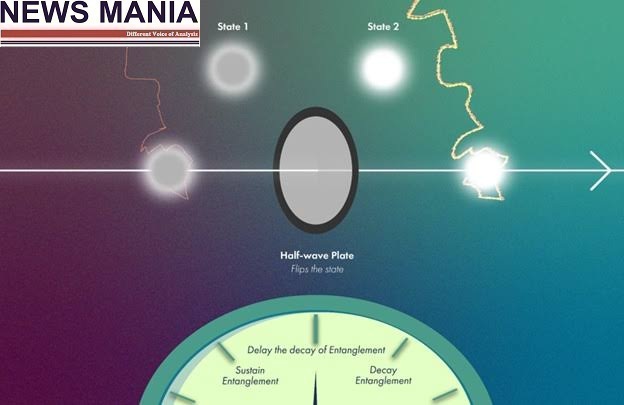
Scientists from India and the United States have demonstrated a method that could help preserve fragile quantum entanglement for longer by applying a single, precisely timed “flip” operation. The research suggests that the timing of an intervention can be as important as the operation itself when controlling the behaviour of quantum systems.
The study was conducted by researchers from the Raman Research Institute (RRI), the University of Calgary and Louisiana State University. It received partial support from the Department of Science and Technology’s National Quantum Mission.
Quantum entanglement occurs when two particles remain strongly correlated even when separated. However, interactions with the surrounding environment can gradually weaken these correlations and eventually destroy them. In some situations, entanglement can disappear suddenly while the individual particles are still retaining some of their quantum properties. This phenomenon is known as “entanglement sudden death”.
To examine whether this process could be controlled, researchers developed an optical experiment representing a two-level quantum system. They used the polarisation of light to represent the two possible states of a particle and employed an optical device called a waveplate to manipulate the system. Instead of allowing the system to undergo its natural decay, researchers introduced a single operation that effectively swapped the populations of the excited and ground states. The researchers found that the outcome depended heavily on when the flip was introduced.
A carefully selected intervention could slow the decay and, in some circumstances, postpone the loss of entanglement. However, applying the same operation at a different stage could instead accelerate the process. The findings therefore show that timing can serve as an important tool for controlling quantum behaviour.
The researchers also encountered unexpected experimental results that did not initially correspond to two standard models used to describe how quantum systems interact with their environment. After extensive theoretical analysis, they identified a tuning parameter that could connect the two models and account for the range of observed behaviour. The findings could have implications for quantum computing and other quantum information technologies, where environmental interactions can cause valuable quantum information to deteriorate.