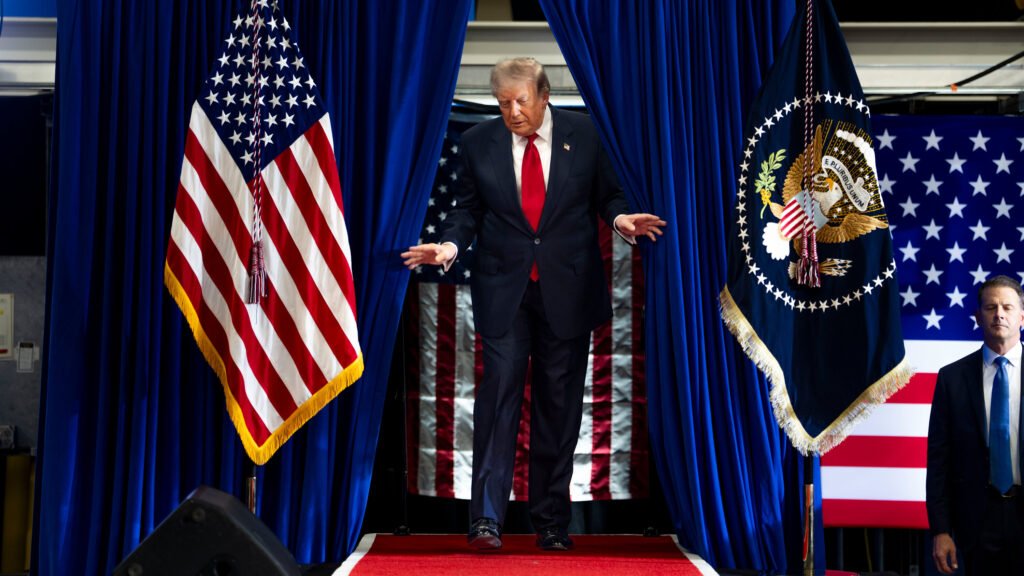
In response to the Russia sanctions measure that passed the US Senate and may subject India and four other nations to tariffs of up to 100%, US President Donald Trump suggested on Wednesday that the law be modified to give him broad authority to slap tariffs on Iran. The late Senator Lindsey Graham’s sanctions measure, which aims to put more economic pressure on Moscow for its invasion of Ukraine, advanced on Tuesday. Interestingly, after China, India is the country that imports the most Russian crude oil.Speaking to reporters in the Oval Office, the US president stated that lawmakers should amend the Russia sanctions bill to grant him broad authority to put tariffs on Iran.
His proposal could slow the legislation as it heads to the House of Representatives. “It shouldn’t be necessary, to be honest. But if it’s necessary I’d like them to add Iran as tariffs, not just as sanctions, I think that’s important, that’s what Lindsey wanted,” he said.
The bill, which passed the Senate 86-12 in a crucial procedural vote, calls for penalties on Russian leaders and gives the US president the authority to impose high tariffs on China, India, Slovakia, Hungary, and Azerbaijan in order to lessen their dependency on Russian gas and oil. The bill would enable Trump to levy tariffs of up to 100% on significant consumers of Russian energy, such as India, if it were to become law. Additionally, the law would give the president the authority to decide whether or not to remove those levies.
While many Democrats are in favour of more stringent sanctions on Russia, some have voiced worries about granting Trump the power to levy tariffs, cautioning that doing so may raise import prices. The odds of the bill passing the Senate and then the House of Representatives, which is set to reconvene in September, may be impacted by such worries.
A few Democrats have stated that they will not support the proposal. It must pass more Senate procedural stages before it can become law. After that, it would go to the House of Representatives to be discussed. Trump accused New Delhi of “fuelling Putin’s war” and announced an additional 25% tax in August 2025, marking the first time the US punished India for its purchases of Russian energy.
As a result, the overall duty on Indian imports was raised to 50%, the same amount levied on Brazil and China. Trade talks came to a halt as a result of the action, further straining relations between Washington and New Delhi. But when the US-Iran war started in February, the Strait of Hormuz was sealed, putting pressure on the world’s energy markets and causing an energy crisis that affected nations all over the world, including India.
India was able to resume its purchases of Russian oil after the US offered a waiver. India’s imports of Russian crude oil reached a record high in June 2026 after the waiver, rising by 34%. The imports were valued at €4.5 billion, or around 36% of Russia’s crude oil export earnings, according to data from the Centre for Research on Energy and Clean Air. Not required, forces based in the Middle East” and lasted for roughly an hour. According to Centcom, all of Iran’s missiles were intercepted. After the strikes were over, Centcom claimed that the US had attacked “military command centers, missile and drone facilities, coastal surveillance and defence sites, and maritime capabilities.”