Delhi Traffic Restrictions During BRICS Summit: Airport, Central and South Delhi Routes To Face Disruptions
News Mania Desk/ Piyal Chatterjee/ 10th September 2026

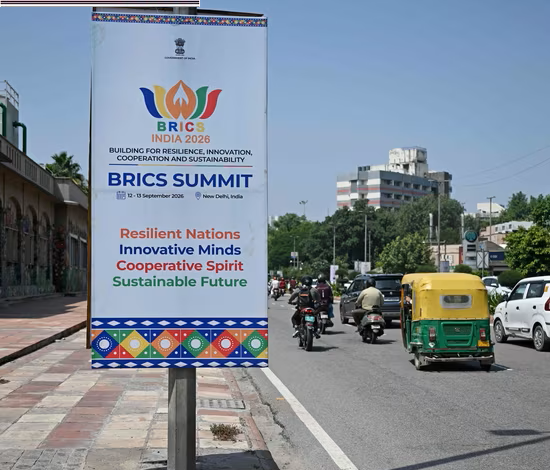
Delhi is set to witness traffic restrictions and diversions during the BRICS Summit from September 11 to 13, with authorities warning commuters to prepare for sudden changes in road conditions as high-security movements take place across the city.
The Delhi Traffic Police has clarified that the capital will not face a complete shutdown during the summit. Normal traffic will continue on roads where security arrangements allow. However, vehicles may be temporarily stopped or diverted whenever convoys carrying foreign leaders and other dignitaries pass through designated routes.
The traffic management plan covers more than 35 roads and includes 22 diversion points. Nearly 4,800 traffic personnel have been deployed to regulate movement. Restrictions are expected to remain in place from September 10 until around September 14.
Officials have warned that the biggest challenge for commuters could be unpredictable travel times. A road may remain open for most of the day but could suddenly be restricted when a VVIP convoy approaches. Authorities expect several dozen high-security movements each day, covering routes between airports, hotels, the summit venue and other locations.
Commuters travelling between Noida and central Delhi, as well as those moving from east Delhi towards central areas, may experience delays. Routes connecting Dwarka and west Delhi with Dhaula Kuan, the airport and south Delhi are also likely to come under pressure.
Traffic restrictions could also affect people travelling to railway stations, hospitals and examination centres. Candidates appearing for examinations such as UPSC, NDA and CDS have been advised to check their routes in advance, carry the required documents and leave early.
The Delhi Metro will continue to operate during the summit, although certain stations or entry and exit gates could face temporary restrictions for security reasons. DTC buses, taxis, autos and app-based cabs will also remain operational, but services passing through controlled areas may be diverted or regulated.
Traffic authorities have coordinated with online navigation platforms so that road restrictions and diversions can be reflected in real time. Residents living in controlled areas will be permitted to travel subject to security arrangements and should carry valid identification and address proof.
Police have also warned people against circulating social media messages claiming that Delhi will observe a complete “bandh”. Authorities have urged commuters to rely only on official traffic advisories and plan their journeys with additional time during the summit period.
With a 105-plane contract, Russia plans to make a significant aviation push in India before the BRICS.
Piyal Chatterjee
In an effort to increase its aviation presence in India ahead of the BRICS meeting, Russia plans to move forward with several aircraft agreements with Indian aviation firms. Up to 105 regional passenger aircraft are part of the proposed arrangements. The IL-114-300 regional passenger aircraft manufactured by United Aircraft Corporation has become a major focus of the two nations’ expanding aviation cooperation.
Negotiations with Indian partners have advanced significantly over the last six months, according to UAC CEO Vadim Badekha, and a number of deals are anticipated to be finalised during the Innoprom India show in New Delhi.
Plans for 50 IL-114-300 aircraft for Pinnacle Air, up to 20 aircraft for Air Kerala, and a further 35 aircraft connected to a memorandum of understanding (MoU) with Sleek Aviation are among the potential agreements. The most recent events come after UAC and Indian company Flamingo Aerospace signed a preliminary agreement in January about the possible supply of six IL-114-300 aircraft. The deal was inked by both parties during the Wings India aviation show in Hyderabad.
India is also being considered by Russia as a possible location for growing aircraft production. UAC reports that talks to produce the SJ-100 regional jet locally in India are about 80% finished, and a deal is anticipated to be inked shortly.
An agreement on the joint licensed manufacturing of the SJ-100 in India was inked earlier this year by UAC and Hindustan Aeronautics Limited (HAL).
As Russia looks to expand industrial collaboration with India beyond traditional defence systems, the aviation engagement is increasing. A potential extension of India-Russian aerospace relations into civil aviation, regional connectivity, and aircraft manufacture is suggested by the planned aircraft deals.
More than 120 Russian and Indian businesses have gathered for Innoprom India, which is taking place in New Delhi from September 9–11 in advance of the BRICS conference.