Uttarakhand Man Builds Electric Flying Car Without an Engineering Degree
News Mania Desk/ Piyal Chatterjee/ 27th October 2026

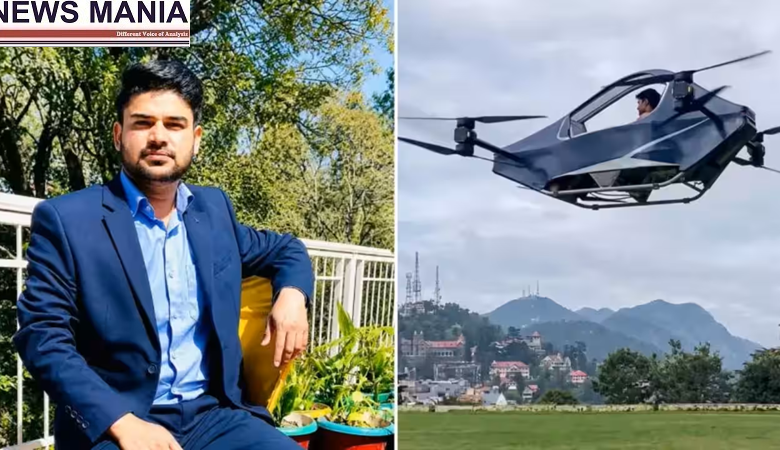
Ravi Tamta, a resident of Uttarakhand’s Almora district, has attracted attention for developing an electric flying car prototype despite having no formal engineering education. A Bachelor of Arts graduate, Tamta spent years learning independently, experimenting with technology and working towards his ambition of creating a vehicle capable of taking off and landing vertically.
His prototype, named HAPIDA SKYNeX, reportedly completed a test flight in August 2026. The battery-powered vehicle uses multiple electric motors and propellers inspired by multirotor drone technology. Its vertical take-off and landing capability could allow it to operate without a conventional runway, potentially offering an alternative mode of transportation in areas where difficult terrain makes road travel challenging.
Tamta’s interest in developing a flying vehicle was shaped partly by his experiences growing up in the mountainous region of Almora. Travelling through winding roads can be time-consuming in Uttarakhand’s hilly terrain, particularly for people seeking urgent medical assistance. He hopes that innovations in aerial mobility could eventually help address some of these transportation challenges.
The inventor began working on his flying-car concept in 2015 through his venture, Hapida Sky Private Limited. Without a formal technical background, he relied on online learning resources, practical experimentation and repeated attempts to develop his ideas. His family also supported his efforts as he continued pursuing the project over several years.
The flying car is not his only reported invention. Tamta has previously worked on devices and equipment intended to address practical problems, including mobile-charging shoes, a smart walking stick designed to assist visually impaired people, a bamboo-splitting machine and firefighting equipment.
Although the successful test flight represents an important milestone, the prototype still faces significant challenges before it can be used commercially. Further technical assessments, safety testing and regulatory approvals would be necessary before it could carry passengers or be introduced as a transport service.
Tamta’s journey highlights the potential of grassroots innovation and self-directed learning. His work demonstrates how individuals outside conventional engineering institutions can explore ambitious technological ideas, while underscoring the extensive testing required to make emerging aviation technologies safe and commercially viable.