
Pakistan’s Nur Khan air base receives a surveillance shield because it is wary of India.
News Mania Desk/ Piyal Chatterjee/16th April 2026

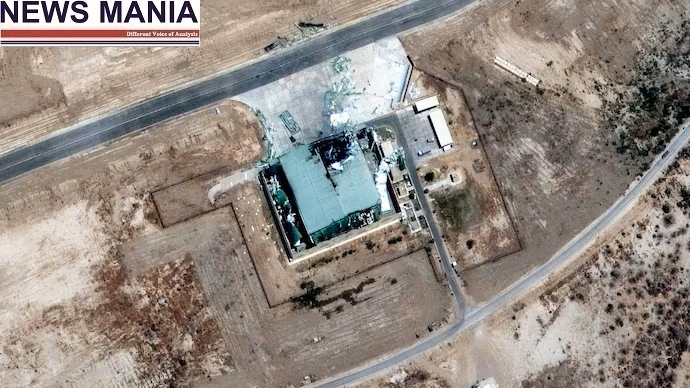
Army chief Asim Munir is transforming Pakistan's crucial Nur Khan air base, which was battered by India during last year's Operation Sindoor, into a stronghold in case of future hostilities. One of Pakistan's most strategically important air bases, Nur Khan, is close to the army headquarters. Recent satellite photos reveal new development activity there. The considerable damage it sustained during the battles is demonstrated by the fact that restoration work is still ongoing almost a year after Operation Sindoor.
New hardened hangars are being built at the Rawalpindi air base, according to satellite photos shared by geo-intelligence specialist Damien Symon. This was not your typical construction, Symon emphasized. Although these hangars safeguard the PAF fleet's environment, experts emphasized that the true goal was to prevent adversaries (read: India) from gathering ISR (intelligence, surveillance, and reconnaissance) over the site. India will probably find it more challenging to keep an eye on things at the air base as a result of this action. It's a case of once bitten, twice shy for Pakistan.
In reaction to the tragic Pahalgam incident, India launched Operation Sindoor, which exposed Pakistan's weakness by attacking 11 of its important military installations without consequence.
After three days of fighting, Pakistan finally asked India for a truce after the attack at Nur Khan, which is only 25 kilometers from Islamabad, the country's capital. It's not just any military installation, after all.
In addition to managing military operations, Nur Khan acts as a high-security port of entry for diplomatic groups. Additionally, it serves as a vital logistics center for Pakistan's military. It is noteworthy because it is close to Pakistan's Strategic Plans Division (SPD), which is in charge of the nation's nuclear weapons.
Defence expert Sandeep Unnithan told that the Iran conflict had laid bare the consequences of drone warfare. "No one's going to park anything in the open in the age of swarm drones," he said.
This is why Pakistan is in a rush to construct hardened hangars to hide its aircraft from such surveillance systems. And no better place to start than the Nur Khan air base, which suffered significant damage in Indian drone strikes.
It was acknowledged by Pakistan's Deputy Prime Minister Ishaq Dar, who also admitted injuries to some personnel. "In 36 hours, at least 80 drones were sent," Dar told Pakistani media.
In addition to creating a huge crater on the runway, the Indian strikes also caused damage to the operations room, hangars, fuel trucks, and an IL-78 air tanker.
The US Vice President JD Vance's arrival at the Nur Khan air base last week to participate in peace negotiations with Iran put the military location in the public eye. As Islamabad positioned itself at the forefront of international diplomacy, the action was perceived as an attempt by Pakistan to convey a message to India.