“Panic Reaction”: Rahul Gandhi Regarding the Women’s Bill and Center Linking Delimitation
News Mania Desk/ Piyal Chatterjee/17th April 2026

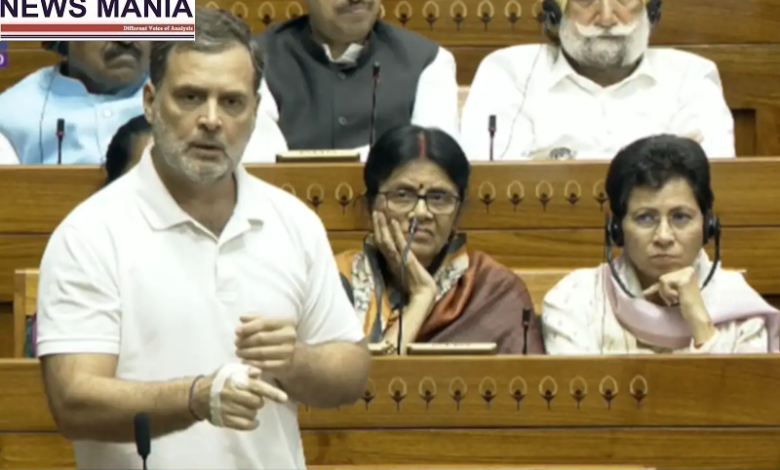
Congress MP Rahul Gandhi cautioned parliament on Friday afternoon that the way the government is enforcing a quota for women—a 33 percent reservation in parliament and state assemblies—is actually an attempt to alter India’s electoral landscape.
It is a “panic reaction”, he also declared, “so that Prime Minister Narendra Modi can show he is pro-women”, particularly before voting for Bengal and Tamil Nadu Assembly elections next week, in which women voters will likely play a key role
Speaking on the second day of a special session to approve laws pertaining to delimitation and the expansion of Lok Sabha seats, he claimed that the government had connected these to the Women’s Reservation Bill in an effort to disadvantage states with more effectively managed population growth.
However, the government has declared that in order to operationalize the women’s quota prior to the 2029 Lok Sabha election, the Lok Sabha must be expanded and delimitated. It has also referred to any party attempting to obstruct this motion as being “against women’s empowerment.”
“But this is not a ‘women’s bill’… it has nothing to do with women’s empowerment,” Gandhi countered, “Women’s Reservation Bill was passed in 2023 with everyone’s support. What is happening now is an attempt to change India’s electoral map.” “Bring back the old bill and we will support it…” Gandhi said snapping back at accusations by the Bharatiya Janata Party, members of which have accused the opposition of politicising the issue of women’s empowerment.
He also said the government is against sharing power with marginalised groups, specifically OBCs. “They are scared of erosion of their strength,” he said, referring to a vote bank of so-called upper classes, “… trying to rejig Indian political map.” “What the government is doing is nothing short of anti-national… the government is telling southern, northeastern, and smaller states ‘for us to remain in power, we are going to take away representation from you’. But we won’t allow you to do it.”
The opposition has been vocal about ‘links’ between the women’s reservation bill and those proposing delimitation. The opposition has claimed that the delimitation process, which involves redrawing parliamentary and assembly areas using demographic data from the 2011 census, favors southern states that have managed population growth.
Northern Hindi-speaking states that have not been as successful and are mostly BJP strongholds, like Uttar Pradesh, which sends the most MPs to the Lok Sabha, will receive more seats if seats are assigned based on this score. Southern political figures, such as MK Stalin, the chief minister of Tamil Nadu, have voiced opposition to this. Additionally, they contend that the exercise makes it less crucial for the BJP to concentrate on southern states in order to win the 2029 election, when it would run for a historic fourth consecutive term.
In the past, the BJP has had difficulty gaining support in the southern states. However, the government has maintained that delimitation will not disadvantage any state. Yesterday, the PM made a “promise” in parliament.
The stand-off was perhaps best explained Thursday by Congress MP Shashi Tharoor.
“The government has a plan to re-delimit constituencies and increase seats in areas where the ruling party is strong. And they are using women’s reservation as an excuse to bring about that change… by trying to amend constitutional amendments they already brought in 2023.”
The opposition has also criticised the move to expand the Lok Sabha to a staggering 850 seats, 15 of which will be allotted to union territories and the rest to states. Apart from concerns a majority of these will be assigned to Hindi-speaking states, the opposition has questioned the need to expand the House to reserve seats for women, rather than simply reserving them now.