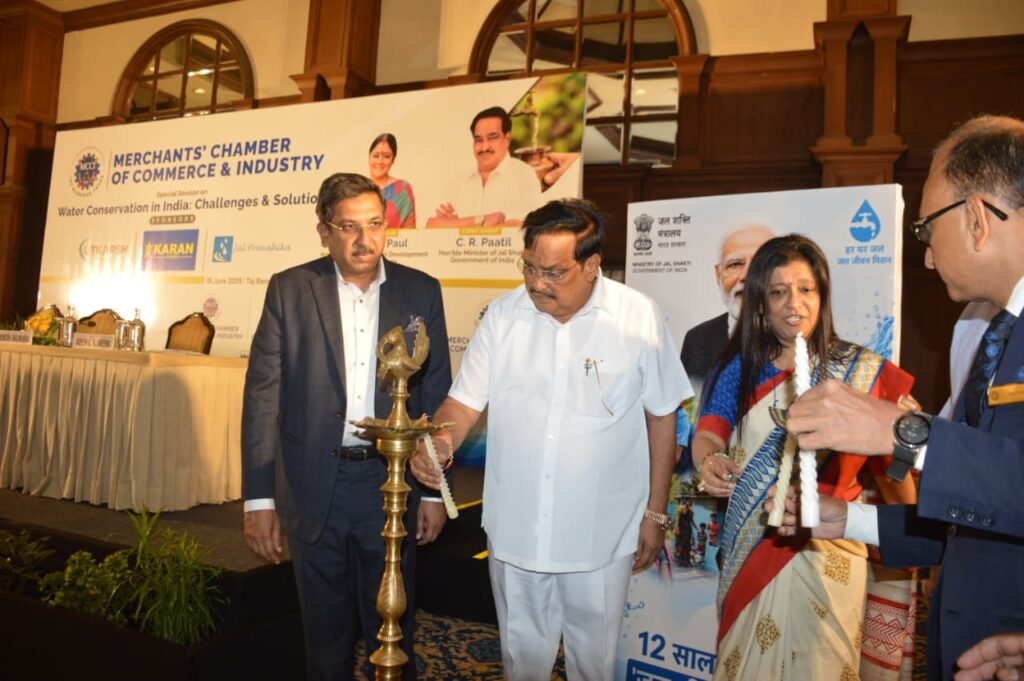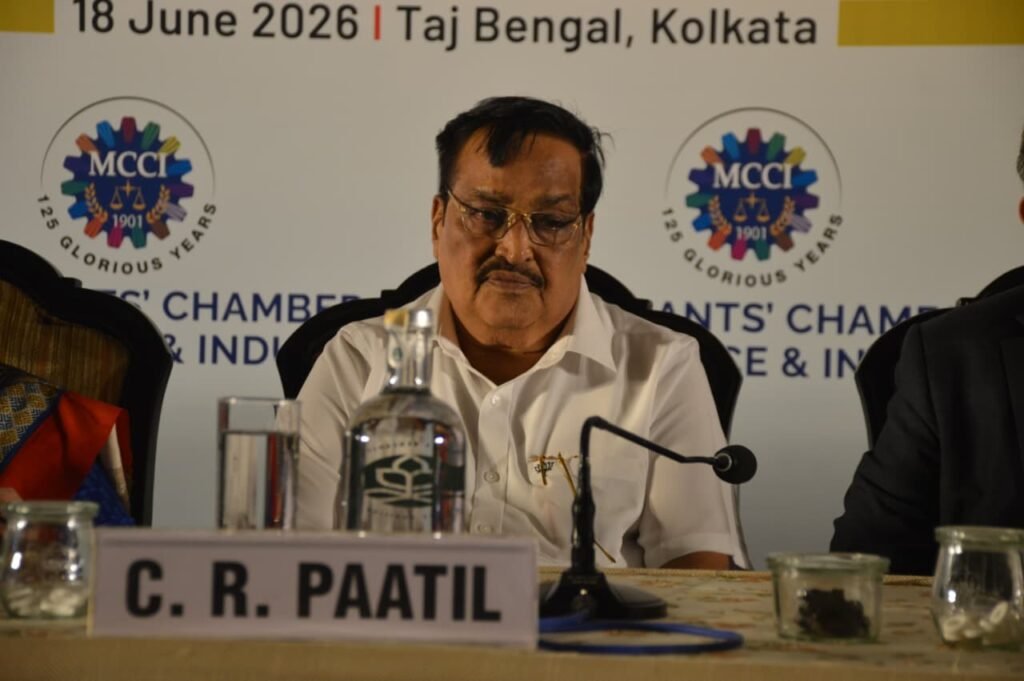

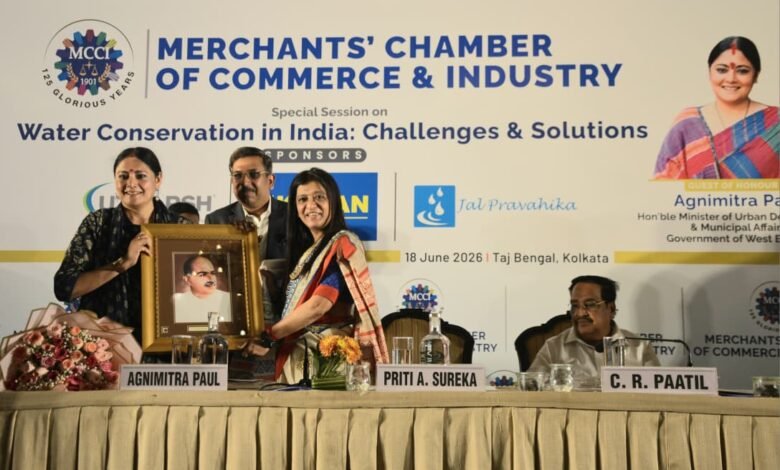
Merchants’ Chamber of Commerce & Industry organised a Special Session on Jal Shakti with Shri C R Paatil, Hon’ble Minister of Jal Shakti, Government of India and Smt. Agnimitra Paul, Hon’ble Minister of Urban Development & Municipal Affairs, Government of West Bengal Today (18 June 2026) at Taj Bengal. Shri Ashok Kumer K. Meena, IAS, Secretary, Department of Drinking Water & Sanitation, Ministry of Jal Shakti, Government of India was also present.
The Topic of the Session was “Water conservation in India: Challenges & Solutions”.
“Whatever projects have been undertaken by the Centre, capital has not been a constraint”, Shri C R Paatil said.
Shri Paatil said that it is the duty of all to conserve water in the interest of future generations by creating conservation structures. The Centre under the leadership of Hon’ble Prime Minister Narendra Modi has made substantial capital outlay for building water conservation projects.
Shri Paatil said in the last 12 years under Prime Minister Modi, several water deficient states like Rajasthan, Madhya Pradesh, Gujarat have made progress to address this problem. The minister alleged that West Bengal has been a laggard on the issue of water conservation and ground water recharge.
According to him, river linking projects amounting to Rs one lakh crore have been envisaged to address the problems of water deficient states.
He said, “water conservation structures are very important for the country. Rain water harvesting is required to recharge the groundwater. And it is also needed for the future generations”.
Under the Jal Jeevan Mission (JJM) aimed at providing drinking water supply to rural households, he said that so far 16 crore homes are being provided with taps. The outlay under this scheme is Rs 1.5 lakh crore, adding that Rs 67,000 crore will have to be spent this year itself.
By 2047, by when India is planning to become a developed nation, India needs to preserve and conserve water. He also urged the industry to treat discharged water.
Smt. Agnimitra Paul said that India is setting a benchmark for macro water management.
Smt. Paul said that due to rapid urbanisation, the pressure on water bodies is increasing. Groundwater recharge has become extremely essential. Smart cities cannot be made if ground water is not secured.
She mentioned that “the West Bengal government is overhauling the municipal structure. The state will implement the Namami Ganga programme of the Centre. Water scarcity also poses a risk to industry.”
She informed that the state is adopting the policies of zero liquid discharge, employing corporate stewardship using CSR funds and also investing in water tech innovations for conservation. We can transform India into a water superpower.
Shri Ashok Kumer K. Meena, IAS, Secretary, Department of Drinking Water & Sanitation, Ministry of Jal Shakti, Government of India informed that the government is propagating the idea of water conservation across the country. Water is essential and so conservation is important. He warned that the next crisis the world will face will be due to water.
He shared that the ministry has recently signed an MoU with the West Bengal government for implementing JJM in the state.
Smt. Priti A. Sureka, President, MCCI in her Welcome Address said that the Jal Jeevan Mission (JJM) is a key scheme of the Jal Shakti Ministry of the Centre which aims at expanding drinking water supply to the rural areas. The scheme is funded in 50:50 basis by the Centre and the states. The onus of implementation of the scheme lies on the states. Currently under JJM version 2.0, the scheme envisages providing functional household tap connections to every rural home. Here, role of the gram panchayat is crucial for operations and maintenance of the infrastructure.
The Session was concluded with hearty Vote of Thanks, proposed by Shri Munish Jhajharia, Senior Vice President, MCCI.