
One of the Universe’s Largest Stars May Be Approaching a Dramatic Supernova
News Mania Desk /Piyal Chatterjee/ 24th February 2026
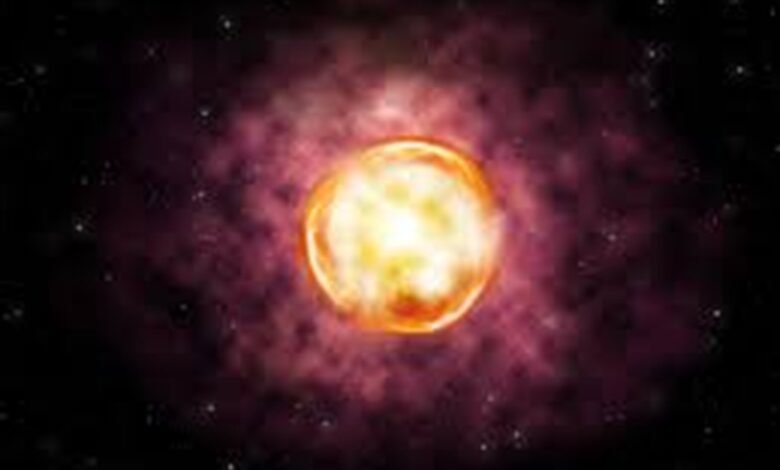
Astronomers have reported that one of the largest known stars in the universe could be entering the final stages of its life, potentially setting the stage for a powerful supernova explosion. The massive star, known as WOH G64, is located in the Large Magellanic Cloud, a neighboring galaxy that orbits the Milky Way. Discovered decades ago, the star has long fascinated scientists because of its extraordinary size. Estimates suggest its radius is more than 1,500 times that of the Sun, making it one of the biggest stars ever identified.
Recent observations indicate that WOH G64 has undergone dramatic changes over the past decade. Around 2013–14, researchers believe the star transitioned from a red supergiant — a late evolutionary phase characterized by a swollen, relatively cool surface — into a rarer and hotter yellow hypergiant stage. Such a transformation is considered unusual and signals that the star may be nearing the end of its nuclear fuel supply.
The findings, led by astronomer Gonzalo Muñoz-Sanchez of the National Observatory of Athens and published in the journal Nature Astronomy, suggest that WOH G64 has begun shedding vast amounts of its outer layers. As massive stars exhaust the hydrogen and heavier elements that power their cores, they become increasingly unstable. Their cores contract and heat up, while their outer atmospheres are expelled into space through intense stellar winds.
Detailed images captured in 2024 by the Very Large Telescope Interferometer revealed a thick, dusty envelope surrounding the star — evidence of significant mass loss. Scientists describe this stage as a potential “pre-supernova” phase, when a star’s internal structure becomes highly unstable before a catastrophic collapse.
Despite these signs, researchers caution that predicting exactly when a supernova will occur remains extremely challenging. Stellar evolution unfolds over millions of years, and while WOH G64’s recent changes appear rapid in astronomical terms, the explosion could still be years, decades, or even longer away.
If the star does explode in the relatively near future, it would provide astronomers with a rare opportunity to observe the death of an enormous star in remarkable detail. Such an event would deepen scientific understanding of how massive stars evolve and how supernovae enrich the universe with heavy elements essential for planets and life. For now, telescopes around the world will continue to monitor WOH G64 closely, watching for further signs that one of the cosmos’s true giants is preparing for its final act.