Tamil Nadu Election Results 2026: How Vijay’s TVK Broke the DMK–AIADMK Political Duopoly
News Mania Desks/ Piyal Chatterjee/ 5th May 2026

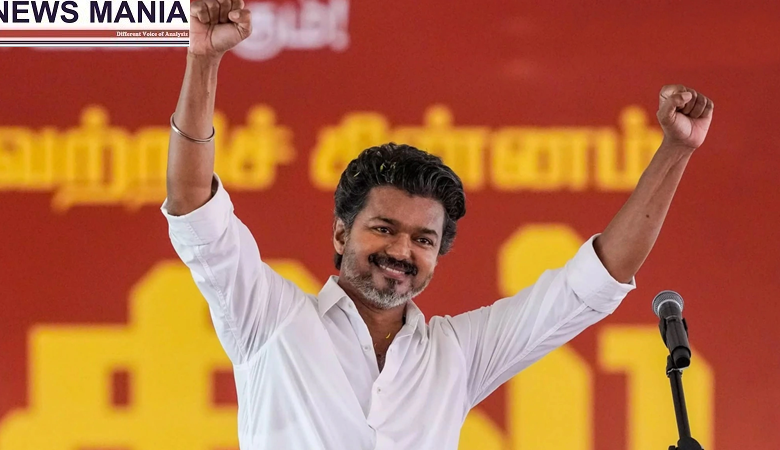
The 2026 Tamil Nadu Assembly election has delivered a dramatic political realignment, with actor-turned-politician Vijay’s Tamilaga Vettri Kazhagam (TVK) emerging as a powerful challenger that has effectively broken the decades-long dominance of the DMK and AIADMK.
For nearly 50 years, Tamil Nadu politics has revolved around a bipolar structure, with power alternating between the two Dravidian giants. However, this election marks a decisive rupture in that pattern, as TVK’s strong debut has reshaped voter behaviour and electoral equations across the state.
According to official trends, TVK has emerged as the single largest political force, crossing the 100-seat mark in a 234-member Assembly and positioning itself close to or just short of a simple majority. The DMK, led by Chief Minister M.K. Stalin, has been pushed to a distant second place, while the AIADMK continues to struggle to retain its relevance in several regions.
The article highlights that Vijay’s appeal has played a central role in this transformation. Unlike traditional parties that rely heavily on cadre networks, caste alliances, and long-established organisational structures, TVK has built momentum largely on personality-driven politics. Vijay’s mass popularity, shaped by his film career and public image, has translated into significant electoral traction, especially among younger and urban voters.
What makes this outcome particularly striking is the speed at which TVK has risen. Contesting its first major state election without the deep organisational machinery of its rivals, the party has managed to convert widespread enthusiasm into concrete electoral gains. Analysts note that this suggests a shift in Tamil Nadu politics, where voter preferences are increasingly influenced by leadership appeal and narrative rather than solely by traditional party structures.
The DMK, while still maintaining a substantial vote share, has suffered unexpected losses in key constituencies. In several areas, the party remained competitive but failed to secure victory, indicating a fragmentation of its traditional support base. The AIADMK, meanwhile, appears to have been further marginalised, with its vote share dispersing in many constituencies where it once held strong influence.
The emergence of TVK has also led to a more complex post-election scenario. With no party securing a clear majority, coalition-building has become central to government formation. Smaller parties and independents are expected to play a crucial role in determining the final political arrangement. The rise of TVK suggests that charisma-driven, media-powered political movements can now compete effectively with traditional party systems, reshaping the state’s democratic landscape in a fundamental way.