NCERT Judiciary Chapter Row Faces Top-Level Scrutiny Amid Supreme Court Concerns
News Mania Desk/ Piyal Chatterjee/ 30th April 2026

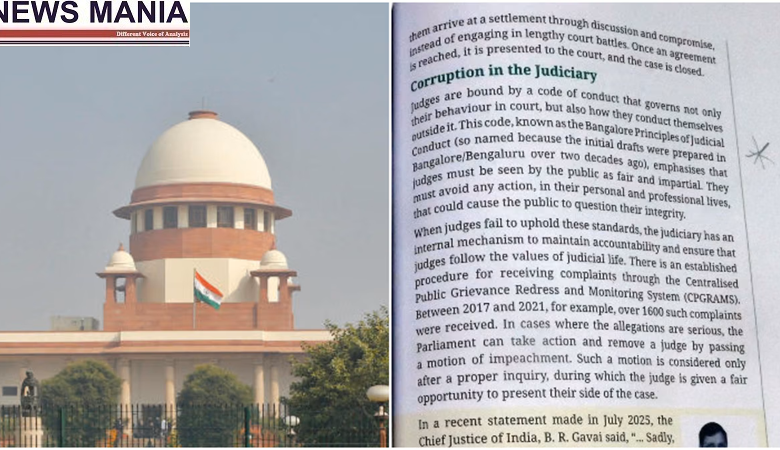
The controversy surrounding a Class 8 Social Science textbook chapter on the judiciary has come under intense scrutiny at the highest levels, including within the National Council of Educational Research and Training (NCERT), according to an expert associated with its development.
The issue erupted after portions of the chapter, which discussed concerns such as alleged corruption and structural challenges within the judiciary, drew sharp criticism from the Supreme Court of India. The court expressed serious reservations about the appropriateness of such content for school students and ordered the withdrawal of the textbook, triggering a nationwide debate on curriculum content and institutional sensitivity.
Amid the backlash, an expert involved in drafting the chapter clarified that the material was not the work of an individual author but rather the outcome of a rigorous, multi-layered review process. The textbook, the expert said, underwent detailed examination by multiple committees, subject specialists, and senior officials within NCERT before being finalised for publication.
The expert further emphasised that the chapter had been “scrutinised at the highest level,” including by the NCERT director, countering claims that the controversial content had bypassed proper oversight. This assertion highlights the structured and institutionalised process followed in textbook development, suggesting that the inclusion of such themes was deliberate rather than inadvertent.
Supporters of the chapter argue that its content aligns with the objectives of the National Education Policy (NEP) 2020, which promotes critical thinking and encourages students to engage with real-world issues. They contend that exposing students to discussions about institutional challenges can foster a more informed and questioning citizenry.
However, the Supreme Court took a different view, stating that references to corruption within the judiciary could undermine public trust in a key democratic institution, particularly among impressionable young learners. The court’s intervention included not only a ban on the textbook but also directives aimed at fixing accountability for the inclusion of the contentious material.
The episode has sparked a wider discourse on the balance between academic freedom and respect for constitutional institutions. It raises important questions about how educational content should navigate sensitive subjects while maintaining factual integrity and pedagogical responsibility.