
For a long-range missile test in the Bay of Bengal, India issues a NOTAM.
News Mania Desks/ Piyal Chatterjee/ 5th May 2026

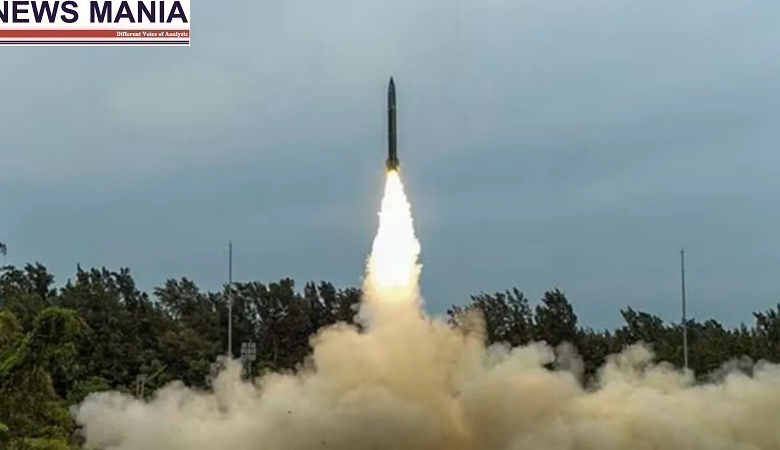
A significant portion of the Bay of Bengal has been designated as a danger zone for a long-range missile test by India in a Notice to Airmen (NOTAM), which is in effect from April 25 to May 6, 2026. The NOTAM indicates preparations for the launch of an intermediate-range ballistic missile (IRBM) and spans a corridor up to about 3,550 km.
According to defense sources, it shows that the flight path and exclusion zone match the Agni-IV’s performance envelope. The IRBM is said to have a range of 3,500–4,000 kilometers. An essential part of India’s nuclear triad and strategic deterrence posture is the Agni-IV, a two-stage, solid-fueled missile with a 1,000-kg warhead.
The timing is noteworthy. The first anniversary of Operation Sindoor, which took place in early May 2025, falls inside the test window. Strategic analysts speculate that the launch would function as a validation exercise as well as a statement of preparedness and capabilities enhancement, even if the Ministry of Defense has not formally connected the test to the anniversary.
India has increased the testing of its strategic missile stockpile in recent months. India’s credible minimum deterrent policy is based on the Agni series, the hypersonic LRAShM, and the submarine-launched K-4.
This possible Agni-IV trial and the extended-range BrahMos cruise missile, which is currently undergoing testing to expand its range to 800 km, indicate a larger modernization drive across both tactical and strategic vectors.When authorities must prohibit civilian aircraft from entering a particular area of airspace, typically during delicate or dangerous activities, a NOTAM is issued. In the past, these advisories have been used to prevent commercial flights from entering operational zones during times of increased military tension, such as the conflict with Pakistan.
Civilian aircraft are prohibited from entering the designated airspace when a NOTAM is in effect. This eliminates the possibility of mid-air mishaps and interference for military aircraft, missiles, and drones. Additionally, it acts as a safety precaution, guaranteeing that non-combat aircraft stay away from locations where military operations are taking place.