Power Struggle in Iran Intensifies as Top Leaders Push to Remove Foreign Minister Amid US Talks
News Mania Desk/ Piyal Chatterjee/1st May 2026

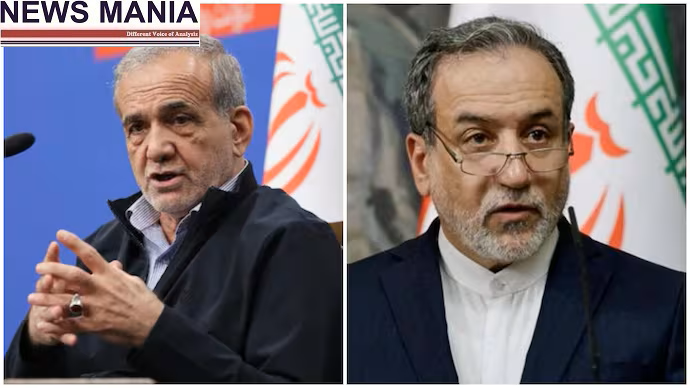
A significant internal rift has reportedly emerged within Iran’s leadership, as President Masoud Pezeshkian and Parliament Speaker Mohammad Bagher Ghalibaf are said to be seeking the removal of Foreign Minister Abbas Araghchi. The development comes at a critical juncture, with Tehran engaged in sensitive diplomatic efforts with the United States following a period of heightened military tensions.
According to reports, the push to unseat Araghchi stems from concerns within Iran’s political leadership that the foreign minister has been operating independently of the president’s office. Sources indicate that he has allegedly conducted key negotiations and strategic communications without sufficient coordination with the civilian government, raising questions about accountability and the chain of command in foreign policy matters.
Adding to the controversy are claims that Araghchi has been working closely with the Islamic Revolutionary Guard Corps (IRGC), a powerful military institution that wields considerable influence in Iran’s political and strategic affairs. This perceived alignment has reportedly alarmed elected leaders, who fear that military interests may be overshadowing civilian authority in shaping the country’s diplomatic approach.
The tensions highlight the complex power dynamics within Iran’s governance structure, where authority is often distributed across multiple centres, including elected officials, military bodies, and religious leadership. Such divisions can lead to competing strategies, particularly during high-stakes international negotiations.
The reported move against Araghchi comes at a delicate time, as Iran and the United States continue indirect talks aimed at reducing tensions and exploring avenues for de-escalation. These discussions follow a series of confrontations earlier this year that brought the two countries close to open conflict. Diplomatic engagement is seen as crucial to maintaining the fragile ceasefire currently in place.
Araghchi has played a prominent role in these negotiations, representing Iran in discussions with global and regional stakeholders. However, the alleged dissatisfaction among top leaders suggests a lack of consensus within Tehran over how the talks should be conducted and what strategic direction the country should pursue.
Analysts view the situation as indicative of a broader divide between factions within Iran’s leadership. On one side are those advocating for diplomatic engagement and a measured approach to easing tensions with the United States. On the other are hardline elements that favour a more assertive stance, often backed by military institutions like the IRGC.
Despite the reports of efforts to remove him, there has been no official confirmation regarding Araghchi’s dismissal. Nevertheless, the situation underscores growing friction at the highest levels of government, which could complicate Iran’s ability to present a unified front in ongoing negotiations.
The potential fallout from this internal discord extends beyond domestic politics. Any instability in Iran’s leadership or shifts in its foreign policy direction could have significant implications for regional security and global diplomacy. With negotiations at a critical stage, a divided leadership may hinder progress and increase uncertainty over future relations between Tehran and Washington.
As events continue to unfold, the international community remains closely watchful, recognising that internal political struggles in Iran could directly influence the trajectory of its engagement with the United States and the broader geopolitical landscape in the Middle East.